

Engineering the Microbiome: How Scientists Are Turning Bacteria Into Living Medicines
Scientists are redesigning gut bacteria to sense biological signals, break down harmful molecules, and produce therapeutic substances inside the body — and a 2025 trial showed these living medicines can be switched off.
In Brief
- The human microbiome contains trillions of microorganisms that influence digestion, metabolism, immunity, and other aspects of human health.
- Scientists are engineering bacteria to detect biological signals, break down harmful molecules, and produce therapeutic substances inside the body.
- Early clinical studies show that engineered microbes can perform specific biological functions in humans, moving the field beyond laboratory experiments.
- A recent breakthrough demonstrated that researchers can control how an engineered bacterium colonizes the human gut—and later clear it—addressing one of the biggest challenges facing living medicines.
- Although safety, genetic stability, manufacturing, and regulation remain challenges, engineered microbes could become a new platform for precision medicine.
Imagine taking a medicine that adapts to what is happening inside your body. Instead of swallowing a fixed dose, what if a treatment could enter the gut, recognize a biological signal, perform a specific task, and then disappear?
That sounds futuristic, but researchers are building medicines that work this way.
The idea starts with the human microbiome—the enormous community of microorganisms living throughout the body, especially in the gut. Many of these microbes are harmless and beneficial, helping break down food, producing useful molecules, interacting with the immune system, and shaping their environment.
That makes them interesting to scientists. Could researchers redesign them to do something useful there?
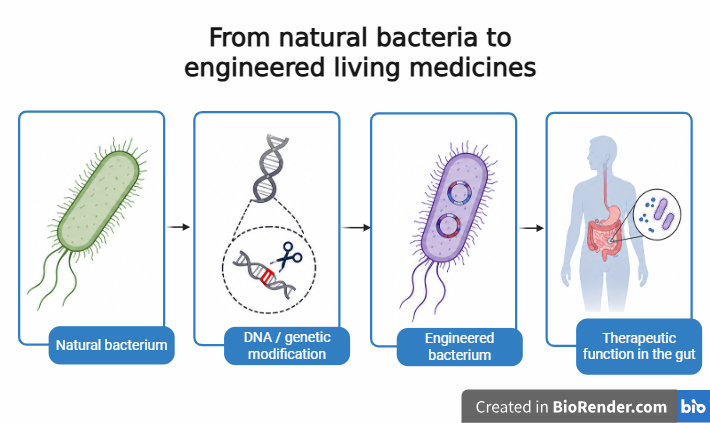
Advances in synthetic biology have made that increasingly possible. Scientists can modify bacterial DNA and give microbes new instructions, allowing them to sense biological signals, produce therapeutic molecules, or break down disease-associated substances.
But engineering the bacteria is only half the problem. A living medicine must behave predictably after it enters a person. Scientists need to know whether it will survive, where it will go, how long it will remain active, and whether it can eventually be removed.
Recent research has begun to address that problem—and the solution involves controlling what the bacteria can eat.
Figure 1. From natural bacteria to engineered living medicines. Natural bacteria can be modified through synthetic biology to gain specific therapeutic functions in the gut. Created with BioRender.com.
From Microbes to Medicines
The human body is an ecosystem. The gut contains a huge community of bacteria and other microorganisms that constantly interact with one another and with their host. For an engineered bacterium, entering that crowded environment is a challenge: it must compete for nutrients and find a way to establish itself among microbes that are already there. Researchers therefore needed a way to give their engineered bacteria an advantage without permanently changing the entire microbial community.
Synthetic biology gives researchers a way to change the rules. Scientists can modify a bacterium's genome and add genetic circuits that determine when certain genes turn on or off. A microbe could, for example, be designed to produce a therapeutic molecule only when it encounters a particular biological signal.
These organisms are sometimes described as engineered live biotherapeutic products or synthetic biotics. Instead of simply delivering a manufactured drug, the microorganism itself carries out a therapeutic function.
One early example involved phenylketonuria, or PKU, a genetic disorder in which the body has difficulty processing the amino acid phenylalanine. Researchers engineered Escherichia coli Nissle 1917 strains to metabolize phenylalanine in the gut. In a 2023 Phase 2 clinical trial, SYNB1618 and SYNB1934 reduced phenylalanine exposure in PKU patients, demonstrating that engineered microbes could perform specific metabolic functions inside the human body (Vockley et al., 2023).
That breakthrough raised a fundamental question: What happens when the medicine itself is alive?
Researchers could engineer bacteria to perform specific tasks, but the harder problem was keeping those bacteria in place, active for the right amount of time, and then removing them. That challenge became the focus of a new generation of microbiome research.
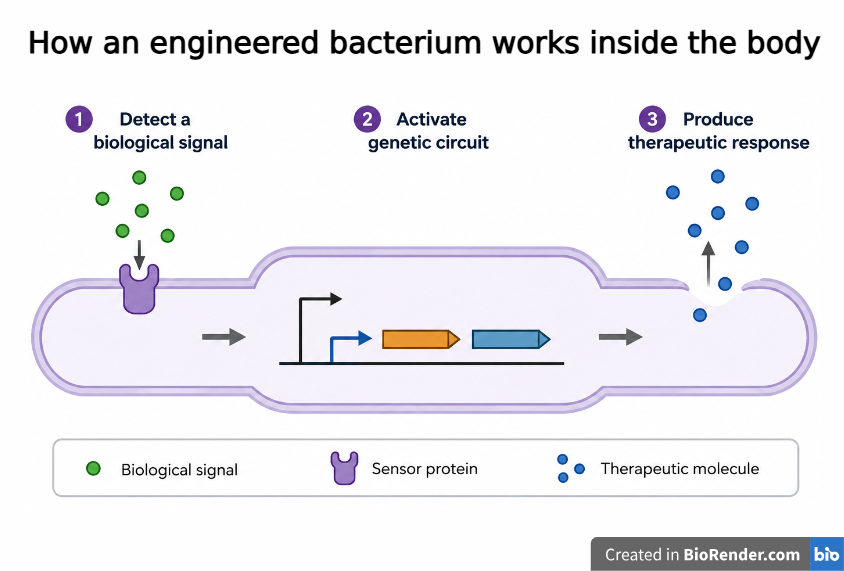
Figure 2. Engineered bacteria can contain genetic instructions that control when they sense biological signals, activate genetic circuits, and produce therapeutic molecules or perform other functions. Created with BioRender.com.
The Hard Part: Controlling a Living Medicine
Conventional drugs allow researchers to determine dose and duration of action, but an engineered bacterium is different. It is a living organism that interacts with thousands of others and adapts to changing conditions.
Therefore, researchers needed a biological way to control how long engineered bacteria remained in the body. If a bacterium disappeared too quickly, it might not treat the disease. If it lingered indefinitely, scientists would have less control over the therapy.
One promising approach came from earlier research on microbial nutrition. Scientists found that engineered bacteria could be given access to a nutrient unavailable to much of the existing gut microbiome. One study used porphyran, a seaweed-derived carbohydrate, to create a nutritional niche for engineered bacteria. Providing the nutrient helped those bacteria establish themselves in the gut even when competing with an existing microbial community (Shepherd et al., 2018).
This solved one problem—but created another. If the bacteria depended on a specific nutrient to survive, could scientists use that same dependency to control when they remained in the body?
Researchers began to wonder whether the same nutritional advantage that helped engineered bacteria establish themselves could also give scientists control over how long they stayed. If the bacteria depended on a nutrient that researchers could provide or withhold, access to that nutrient could become a way to regulate the living medicine.
A Bacterium With an Off Switch
In 2025, Weston Whitaker and colleagues reported a major breakthrough in Science. The researchers built on the earlier porphyran strategy by engineering a strain of Phocaeicola vulgatus whose survival depended on porphyran.
The team altered the regulation of an essential bacterial gene so that it was activated by porphyran. When porphyran was available, the engineered bacteria could maintain the essential function needed for survival. When porphyran was removed, that function could no longer be maintained.
The researchers were no longer simply trying to make bacteria colonize the gut. They were trying to make colonization controllable.
The researchers adapted the system into a potential treatment for enteric hyperoxaluria, a condition that can contribute to recurrent calcium oxalate kidney stones. The bacterium was engineered to carry a five-gene pathway that could break down oxalate, creating a microbial system with two key features: it could perform a therapeutic function, and its presence could be regulated through access to porphyran (Whitaker et al., 2025).
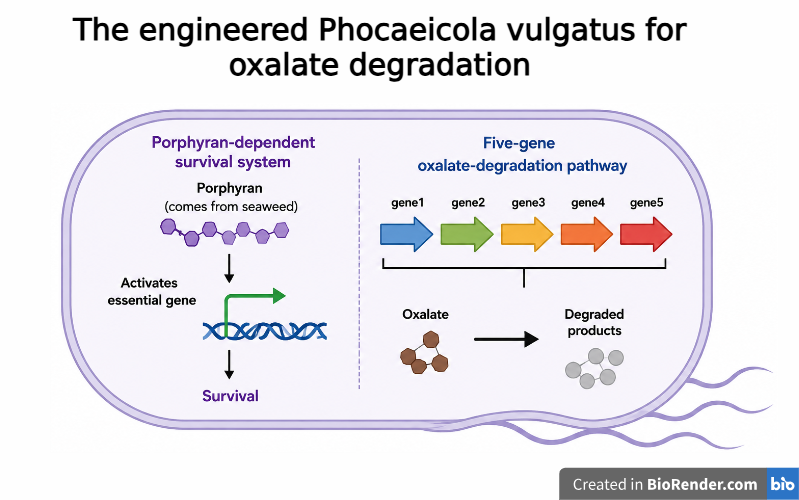
Figure 3. The engineered Phocaeicola vulgatus uses a porphyran-dependent system for survival and a five-gene pathway to break down oxalate into degraded products. Created with BioRender.com.
Before testing the approach in people, the researchers studied whether the engineered bacteria could perform their intended function in animal models. The results provided evidence that the bacteria could reduce oxalate levels.
Then came the tougher test: Could the system be controlled in humans?
In a Phase 1/2a clinical trial, researchers tested the engineered bacteria in people. The bacteria's abundance increased as porphyran exposure increased, while removing the nutrient reversed engraftment. The study also reported reduced urinary oxalate levels (Whitaker et al., 2025).
The trial results represented a significant shift in the direction of microbial medicine research. For the first time, researchers demonstrated in humans that they could influence the presence of an engineered therapeutic bacterium by controlling its access to a nutrient. The living medicine was no longer simply being introduced into the body; researchers had a way to influence when it could remain there.
A 2025 Nature Biotechnology research highlight described the work as a step toward solving a fundamental problem in microbial cell therapy: engineered bacteria must colonize the gut effectively but also be cleared when treatment ends (Marchal, 2025).
The experiment demonstrated something earlier generations of microbial engineering had struggled to achieve: a living medicine could be designed with a controllable relationship to its environment.
The question had changed. It was no longer just, "Can scientists engineer bacteria?" It was, "Can scientists engineer bacteria into medicines that can be controlled?"
That distinction matters. A treatment that works only in a laboratory is very different from one that can be introduced into a human body, perform a useful function, and then be regulated.
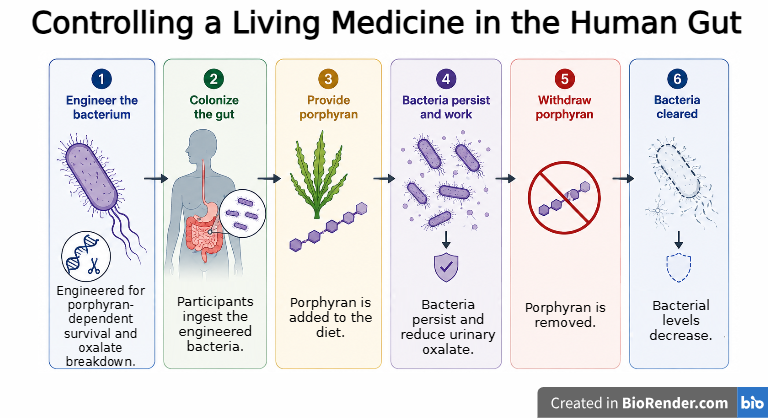
Figure 4. The 2025 human trial demonstrated that an engineered microbial therapy could perform a therapeutic function while its colonization remained controllable, addressing a major challenge in developing living medicines. Created with BioRender.com.
Where Could Living Medicines Go Next?
The controlled-colonization study is one example of how researchers are making engineered bacteria more practical. Other teams are exploring what these microbes can do once inside the body.
Metabolic disorders are one area of interest. In PKU, engineered bacteria have been designed to break down phenylalanine before it contributes to elevated levels in the body (Vockley et al., 2023). Similar strategies could be adapted to other conditions involving molecules that accumulate or need to be modified.
The gastrointestinal tract is another natural target. Researchers are investigating whether engineered bacteria could detect signals associated with intestinal inflammation and release therapeutic molecules near affected tissue. The goal is to make the microbe respond to its biological environment rather than release the same treatment continuously.
Cancer research is pushing the idea further. In a 2024 Nature study, researchers engineered probiotic E. coli Nissle 1917 to deliver tumor-specific neoantigens and stimulate an immune response against cancer. In mouse models, the engineered bacteria helped activate tumor-specific immune responses and produced antitumor effects (Redenti et al., 2024). The work remains preclinical, but it demonstrates how bacteria could serve as programmable delivery systems for cancer immunotherapy.
Across these examples, the same principle keeps appearing: give a microorganism a useful biological job, then build enough control around it to make that job practical.
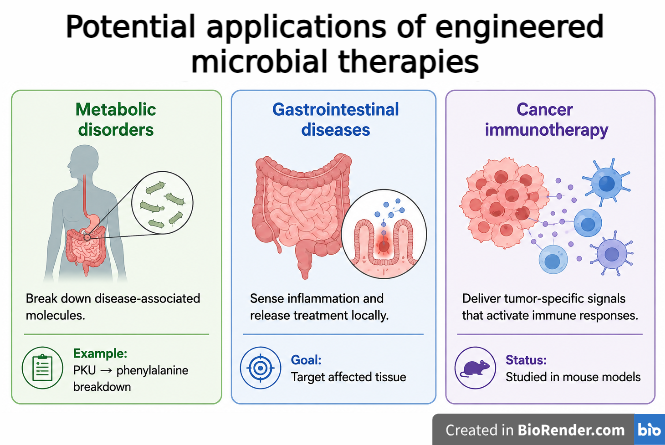
Figure 5. Engineered microbes are being investigated as programmable therapies for metabolic disorders, gastrointestinal diseases, and cancer immunotherapy, demonstrating the range of potential applications for living medicines. Created with BioRender.com.
What Still Has to Be Solved?
Engineered medicines hold promise, but the field is still emerging. Several challenges must be addressed before engineered microbial therapies become routine medical treatments.
Safety and control are major concerns. Engineered bacteria respond to their environment and interact with existing microbial communities. Researchers need to understand how long these microbes remain active, where they travel, and how their activity can be controlled.
Genetic stability is another challenge. Engineered bacteria must maintain the traits that make them therapeutic. The 2025 controlled-colonization study also highlighted the need to monitor the movement of engineered genetic material between microorganisms (Whitaker et al., 2025).
Microbiome interactions add another layer of complexity. The gut contains thousands of microbial species competing and cooperating with one another. A bacterium that behaves predictably in a laboratory may behave differently within a person's existing microbiome.
Manufacturing poses a practical challenge as well. Researchers must produce microbial therapies consistently, ensuring that each batch has the correct genetic characteristics and therapeutic activity.
Regulation is also complicated because engineered microbes do not fit neatly into the traditional idea of a drug. They are living organisms that grow, respond to their surroundings, and interact with other organisms inside the body.
These challenges are significant, but they are also driving the next generation of research. The goal is to make bacteria perform a useful function safely, consistently, and predictably.
Why This Matters
Engineering the microbiome represents a broader shift in how scientists think about medicine. Instead of treating bacteria as something to eliminate, researchers are learning how to use microorganisms as biological tools.
The most interesting possibility may be what this means for precision medicine. A traditional drug is manufactured outside the body and delivered to a patient. An engineered microbe could respond to the environment it encounters inside the body, creating possibilities for treatments that are more responsive and localized.
A bacterium could detect a biological condition, carry out a programmed reaction, and potentially be removed once its job is finished. This would make the treatment less like a passive dose of medicine and more like a biological system designed to respond to the patient's environment.
Making this vision work requires collaboration across many fields. Microbiologists study how the organisms behave. Geneticists and synthetic biologists design their DNA. Biomedical engineers develop systems for controlling them. Computational scientists analyze microbial communities and biological data. Physicians and clinical researchers determine whether these technologies actually help patients.
For students interested in biology, medicine, biotechnology, or engineering, microbiome engineering shows how these subjects can overlap in a single problem. The next breakthrough in medicine could come from someone studying bacterial behavior, designing genetic circuits, developing a new control system, analyzing microbiome data, or translating laboratory discoveries into patient care.
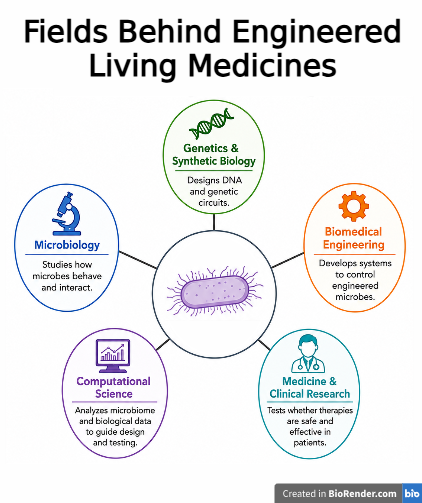
Figure 6. Developing engineered living medicines requires collaboration across microbiology, genetics and synthetic biology, biomedical engineering, computational science, and clinical research, connecting microbial design with the development and testing of new therapies. Created with BioRender.com.
Conclusion
The human microbiome was once studied primarily as a community of microorganisms living inside us. Synthetic biology has given researchers a new perspective: an environment where living organisms can be programmed to perform medical tasks.
Early clinical work showed that engineered bacteria could metabolize phenylalanine in people with PKU (Vockley et al., 2023). More recent research has pushed beyond that. Scientists are now asking how to control where engineered microbes live, how long they remain active, and how to remove them.
The 2025 controlled-colonization study offered a crucial step toward answering those questions. Researchers linked bacterial survival to a controllable nutrient, demonstrating reversible engraftment of an engineered microbe in humans while testing its therapeutic function (Whitaker et al., 2025). The study also exposed challenges that still need to be solved, particularly genetic stability and interactions between engineered bacteria and the existing microbiome.
That combination of progress and unanswered questions makes microbiome engineering compelling. Science is no longer just about imagining bacteria as medicines. Researchers are figuring out how to make that idea controllable enough to test in the real world.
If these challenges can be overcome, engineered microbes could become a new kind of medicine—one that senses, responds, and acts inside the body.
References
- Marchal, I. (2025). Reversible engraftment of an engineered microbe in the human gut. Nature Biotechnology, 43, 1241. https://doi.org/10.1038/s41587-025-02790-x
- Redenti, A., Im, J., Redenti, B., Li, F., Rouanne, M., Sheng, Z., Sun, W., Gurbatri, C. R., Huang, S., Komaranchath, M., Jang, Y., Hahn, J., Ballister, E. R., Vincent, R. L., Vardoshivilli, A., Danino, T., & Arpaia, N. (2024). Probiotic neoantigen delivery vectors for precision cancer immunotherapy. Nature, 635, 453–461. https://doi.org/10.1038/s41586-024-08033-4
- Shepherd, E. S., DeLoache, W. C., Pruss, K. M., Whitaker, W. R., & Sonnenburg, J. L. (2018). An exclusive metabolic niche enables strain engraftment in the gut microbiota. Nature, 557, 434–438. https://doi.org/10.1038/s41586-018-0092-2
- Vockley, J., Sondheimer, N., Puurunen, M., Diaz, G. A., Ginevic, I., Grange, D. K., Harding, C., Northrup, H., Phillips, J. A., Searle, S., Thomas, J. A., Zori, R., Denney, W. S., Ernst, S. L., Humphreys, K., McWhorter, N., Kurtz, C., & Brennan, A. M. (2023). Efficacy and safety of a synthetic biotic for treatment of phenylketonuria: A phase 2 clinical trial. Nature Metabolism, 5, 1685–1690. https://doi.org/10.1038/s42255-023-00897-6
- Whitaker, W. R., Russ, Z. N., Shepherd, E. S., Popov, L. M., Louie, A., Lam, K., Zong, D. M., Gill, C. C. C., Gehrig, J. L., Rishi, H. S., Tan, J. A., Buness, A., Godoy, J., Banta, D., Jaidka, S., Wilson, K., Flood, J., Bukshpun, P., Yocum, R., Cook, D. N., Warsi, T., McLean, L., Sonnenburg, J. L., & DeLoache, W. C. (2025). Controlled colonization of the human gut with a genetically engineered microbial therapeutic. Science, 389(6757), 303–308. https://doi.org/10.1126/science.adu8000